


Are India’s Forests at a Historic Legal Crossroads? Delhi High Court Hears Landmark PIL on the National Board for Wildlife
A landmark Public Interest Litigation filed by Dr. M. K. Ranjitsinh and other conservation experts seeks judicial scrutiny of the National Board for Wildlife's decision-making process, raising important questions over approvals affecting Tiger Reserves, National Parks, Wildlife Sanctuaries and Eco-Sensitive Zones across India. The matter remains pending before the Delhi High Court

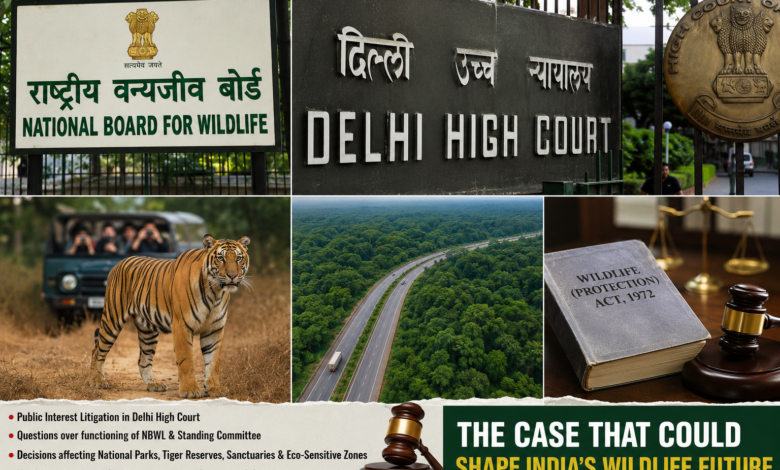
Are India’s Forests Facing Their Biggest Legal Crossroads?
Historic Public Interest Litigation Before the Delhi High Court Raises Serious Questions Over the Functioning of the National Board for Wildlife; Judicial Review Sought on Decision-Making Affecting Tiger Reserves, National Parks, Wildlife Sanctuaries and Eco-Sensitive Zones
Special Investigative Report | Nature Times Investigation
By Special Correspondent
New Delhi / Jaipur / 9 July 2026
India’s forests are far more than vast stretches of trees. They are the foundation of the country’s ecological security, water security, climate resilience and one of the richest biodiversity landscapes on Earth. From the snow-clad Himalayas and the rainforests of the Western Ghats to the mangroves of the Sundarbans and the deserts of Rajasthan, these ecosystems support nearly three-fourths of the world’s wild tigers, the Asiatic Lion, Asian Elephant, Snow Leopard, One-horned Rhinoceros, Gharial, Gangetic Dolphin and thousands of rare plant and animal species. Over the past five decades, India has built one of the world’s most comprehensive legal and institutional frameworks for wildlife conservation.
Today, however, that very framework has come under one of its most significant judicial examinations.
A far-reaching Public Interest Litigation (PIL) pending before the Delhi High Court has raised fundamental questions regarding the functioning of the National Board for Wildlife (NBWL) and its Standing Committee (SC-NBWL). The litigation does not challenge a single road, mine, hotel, state or Tiger Reserve. Instead, it seeks judicial scrutiny of the institutional framework governing decisions related to protected areas across India, including National Parks, Wildlife Sanctuaries, Tiger Reserves, Eco-Sensitive Zones and Wildlife Corridors. The allegations and arguments contained in the petition represent the petitioners’ claims, and the Delhi High Court has not yet delivered its final judgment on these issues.
The significance of this litigation is further heightened by the fact that one of its principal petitioners is Dr. M. K. Ranjitsinh (Retd. IAS), widely regarded as one of the principal architects of modern wildlife conservation in India. A former Additional Secretary in the Ministry of Environment and Forests, Dr. Ranjitsinh played a pivotal role in strengthening India’s wildlife conservation framework, protected area policies and the implementation of the Wildlife (Protection) Act. He is joined in the petition by several former senior Indian Forest Service officers, conservation scientists and environmental experts.

Dr. M. K. Ranjitsinh
According to the petition, the National Board for Wildlife was never intended merely to function as an authority granting approvals for development projects. Rather, Parliament envisioned it as India’s highest statutory institution for wildlife conservation, responsible for guiding national conservation policy, providing independent scientific advice to governments and ensuring that development remains consistent with the objectives of wildlife protection and ecological sustainability. The petitioners contend that over time this broader institutional role has gradually diminished, with decision-making increasingly concentrated within the Standing Committee. These submissions represent the petitioners’ position and remain subject to judicial determination.
The petition further recalls that in 2011, Dr. M. K. Ranjitsinh himself urged the Standing Committee to adopt transparent procedural rules governing project appraisal, decision-making and post-clearance compliance. Acting upon his recommendations, a sub-committee chaired by him was constituted to prepare detailed procedural guidelines. The petitioners contend that many of these proposed institutional reforms were never fully implemented and that this forms one of the central concerns now placed before the Delhi High Court.
According to the petition, a large number of development proposals affecting National Parks, Wildlife Sanctuaries, Tiger Reserves and Eco-Sensitive Zones were approved during the past decade. The documents refer to highways, railway projects, mining operations, industrial infrastructure, pipelines, oil and gas projects, water infrastructure, mobile towers, tourism facilities and several other categories of development. The petitioners argue that in several meetings an unusually large number of proposals were considered together, raising concerns over whether each proposal received the rigorous ecological, scientific and legal evaluation required under Indian law. These allegations remain under judicial consideration.
The petition also states that after 2012, the full National Board for Wildlife reportedly did not convene for nearly thirteen years, with most important decisions being taken by its Standing Committee. The petitioners argue that the full Board—comprising Members of Parliament, representatives of State Governments, scientists, conservation experts and civil society members—was intended to provide broader institutional oversight and multidisciplinary deliberation on matters of national conservation importance.
The legal foundation of the PIL rests primarily upon Sections 29 and 35(6) of the Wildlife (Protection) Act, 1972, which, according to the petitioners, permit alteration or diversion of land within National Parks and Wildlife Sanctuaries only when it directly serves wildlife conservation and better management. They argue that projects capable of affecting wildlife habitats, biodiversity, ecological integrity or wildlife corridors must therefore undergo the highest level of scientific and legal scrutiny.
The petition further invokes Articles 21, 48A and 51A(g) of the Constitution of India, asserting that environmental protection is not merely an administrative responsibility but a constitutional obligation. According to the petitioners, degradation of protected landscapes ultimately threatens biodiversity, water security, climate resilience, agriculture and the constitutional right to a healthy environment.
Several landmark judgments of the Supreme Court of India, including the T.N. Godavarman and Lafarge Umiam Mining decisions, have also been cited in support of the petition. The petitioners contend that these judgments require decisions concerning protected areas, Eco-Sensitive Zones and Wildlife Corridors to be transparent, scientifically informed and fully consistent with statutory safeguards.
The petition draws upon several conservation landscapes across India, including the Sariska Tiger Reserve in Rajasthan, the Panna Tiger Reserve and the Ken–Betwa River Linking Project, the Tadoba–Kanhalgaon–Tipeshwar Tiger Corridor in Maharashtra, the Hastinapur Wildlife Sanctuary in Uttar Pradesh, and the Galathea Bay and Megapode Wildlife Sanctuaries in the Andaman and Nicobar Islands. According to the petitioners, these examples illustrate why decision-making affecting protected landscapes requires rigorous ecological assessment and judicial scrutiny.
The petition also argues that wildlife conservation today extends beyond the boundaries of protected areas. Modern conservation science recognizes that Tigers, Elephants, Leopards and other wide-ranging species depend upon interconnected forest landscapes and secure wildlife corridors for long-term survival. Fragmentation of these ecological linkages, the petitioners contend, may increase habitat isolation, genetic fragmentation and human-wildlife conflict. They therefore advocate independent wildlife impact assessments, scientific corridor evaluation, examination of alternative alignments and robust post-clearance compliance monitoring for projects affecting protected landscapes.
At the same time, the government’s perspective remains equally significant. The Union and State Governments may argue before the Court that highways, railways, energy infrastructure, drinking water projects, communication systems and national security initiatives are essential public-interest activities, and that statutory environmental procedures are duly followed before approvals are granted. Accordingly, no definitive conclusion can be drawn until the judicial proceedings are completed and all parties have been heard.
Nature Times Analysis
The true significance of this litigation extends far beyond any individual project or administrative decision. It raises a far more fundamental question:
Are India’s apex wildlife institutions adequately equipped—with scientific expertise, transparency and institutional accountability—to safeguard the country’s natural heritage while accommodating the legitimate demands of economic development?
If the Court concludes that the existing institutional framework adequately satisfies constitutional and statutory requirements, the current system may receive judicial affirmation. If, however, broader reforms are considered necessary, the case could become the foundation for one of the most significant institutional transformations in India’s wildlife governance since the enactment of the Wildlife (Protection) Act.
For this reason, the proceedings before the Delhi High Court represent far more than an ordinary environmental lawsuit. They may ultimately emerge as a defining chapter in the legal and institutional history of wildlife conservation in India.